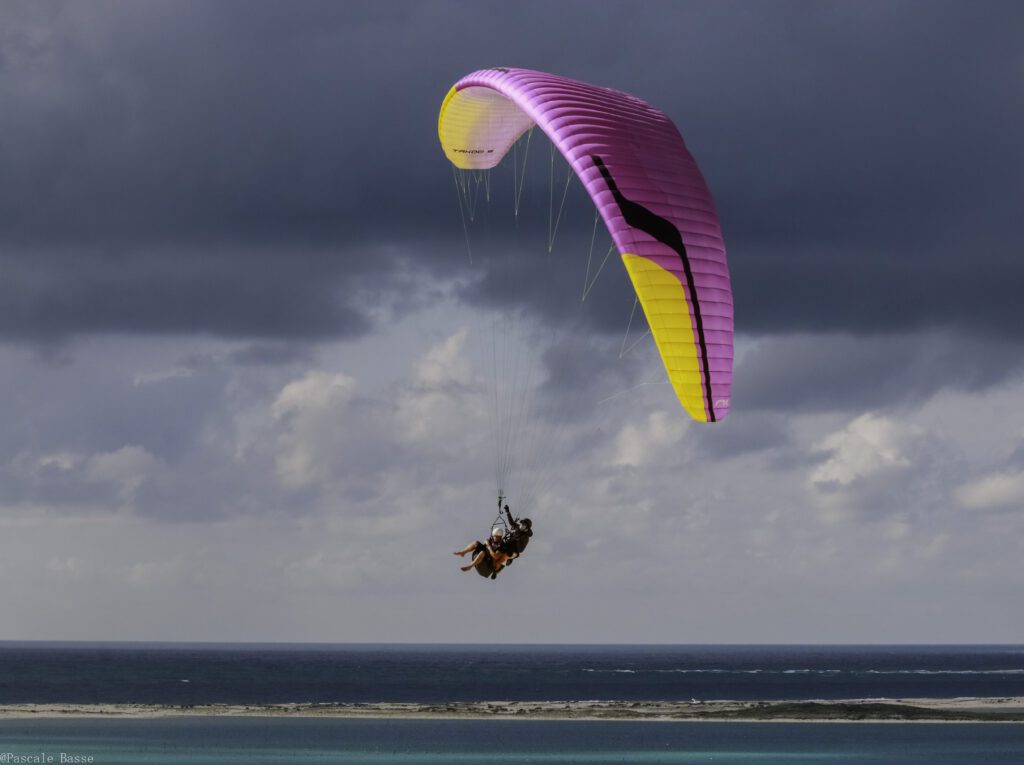
To begin with, it's important to know that paragliders, which take off and land using the pilot's own muscular strength, fall into the category of ultra-light gliders (ULG).
Paragliding is derived from the parachute, so let's start by talking about Leonardo da Vinci's invention of the coated linen parachute in 1485. The parachute evolved over the years, starting in the 20th century.th century, at first mainly for military use and also thanks to NASA.
In 1948 Gertrude Rogallo and her husband Francis Rogallo, a NASA engineer, invented a self-inflating profile they called a Parawing wing, which later evolved into the flexible Rogallo wing still used as a steerable rescue parachute. This invention led to the development of the delta wing.
But thehistory of paragliding really began in 1965 with the development of Sailwing by Dave Barish. He called this new discipline slope soaring.
At the same time as this invention, Domina Jalbert was thinking of a box parachute, which he saw as a replacement for the round parachute: the parafoil.
From there, parachuting evolved into free-fall. Paragliding would later use the concepts of double surface and caissons.
Between 1966 and 1968, Dave Barish and Dan Poynter demonstrated slope soaring on a ski jump, and presented their concept in ski resorts. Mountaineers were interested, as it could be a fast and efficient way of descending after an ascent.
In 1971, Steve Snyder marketed the first box canopy in the USA under the name Paraplane, and in 1972 the first canopy of this type appeared at the French Parachuting Championships. By the end of the 1970s, only this type of canopy was used at these championships.
Paragliding was born in 1978. Members of the Annemasse paraclub in Haute-Savoie decided to use their parachutes to take off from a mountain, and the choice fell on the Perthuiset mountain in the commune of Mieussy. André Bohn, a top-level Swiss parachute competitor, organizes the first takeoff. Jean-Claude Bétemps tests the take-off and immediately rests on the slope. André Bohn then decides to take off and land at the bottom of the valley on the Mieussy soccer field. This was his first flight on a slope. Jean-Claude Betemps followed, and the next day and in the days that followed, Gérard Bosson and several members of the Para-Club d'Annemasse, Michel Didriche, Gérard Cantin, Marc Baruch, Daniel Marschal and others, took their turn on the historic flight.
On May 5, 1979, Gérard Bosson from Viuz en Sallaz, Georges Perret from Annecy and Michel Didriche from Mieussy founded the world's first paragliding club: "Les Choucas".
They soon bring other skydivers with them to practice slope flying. The first training course is organized at Mieussy by Michel Sarthe and Michel Didriche, and is open to experienced skydivers with the FFP (Fédération Française de Parachutisme) wing qualification.
A little later, access to training will be authorized for "non-practitioners". Marc Buffet and Jean-François Baudet from Mieussy will be the first two to be trained in this new discipline.
The main attraction of slope flying for parachutists at the time was that it enabled them to practice precision landing, without having to use the more expensive and less practical airplane.
In the early years, the French Parachuting Federation helped to develop this activity by organizing and regulating the practice.
Visit FFVL (Fédération Française de Vol Libre) took over as the delegated federation. It structured paragliding as a free-flight activity alongside hang-gliding. This led to national development and access to paragliding, thanks to the many hang-gliding schools converted to paragliding.
Since 1978, paragliding has developed worldwide. Competitions, national and world championships, bring together the best pilots and prove the dynamism of this demanding but exciting discipline.
In 1985, Laurent de Kalbermatten invented the "Randonneuse", the first glider designed specifically for paragliding. It was more powerful and easier to inflate than the parachutes used until then. Jean-Claude Bétemps said it was just a copy of a 9-cell parachute, but by simply changing the fabric to make it non-porous and the line material to eliminate elasticity, it already gained one point in glide ratio (glide ratio corresponds to the distance in meters covered horizontally when one meter is lost vertically).
From then on, paragliding continued to evolve, both in terms of equipment and practice. The first Paragliding World Championships were held in 1989 in Kössen, Austria.
Initially used mainly by mountaineers, paragliding has evolved into an air sport in its own right, with different disciplines: aerobatics, distance flying, precision landing, walking and flying.
In terms of performance, competition gliders currently exceed 11 finesse, and cross-country flights exceed 500km.
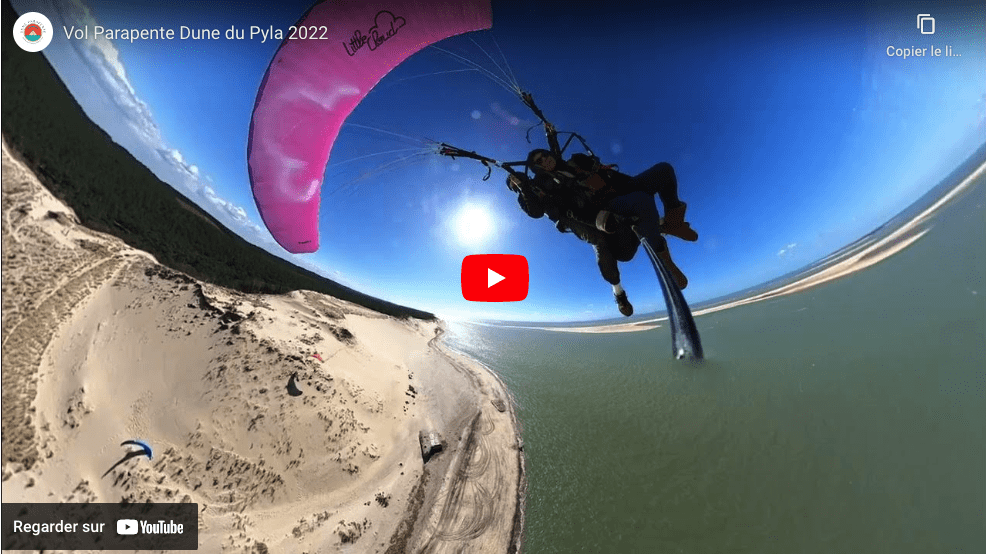
So if you too would like to try your hand at hang-gliding on a paragliding experience on the Dune du Pilatdon't hesitate to book a flight with Dune Parapente.